































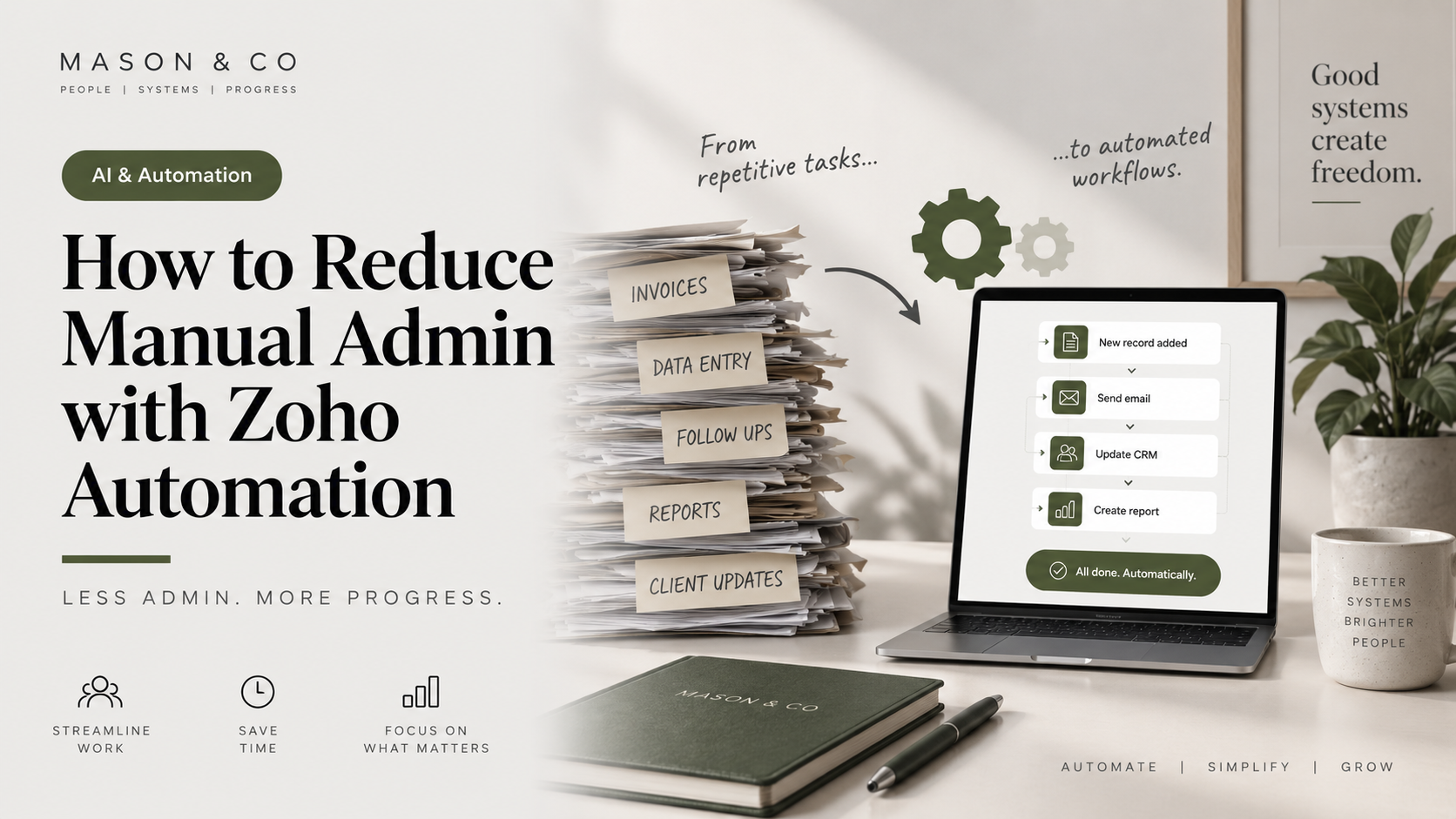
One of the most common reasons organisations invest in Zoho One is automation.
The expectation is straightforward: connect the applications, automate the repetitive work and give people time back.
Yet I regularly see organisations with significant Zoho estates where employees are still copying information between systems, updating spreadsheets, sending routine emails manually, chasing approvals and checking whether processes have completed.
The technology is there. The automation often is too.
The problem is that automation has been added around the administration rather than redesigning the process that created it.
If I wanted to reduce manual administration across Zoho One, I would not start by asking:
“What can we automate?”
I would start with:
“Why does this task exist in the first place?”
That distinction matters, because the best automation is sometimes the one you never have to build.
It is very easy to open Zoho Flow, CRM workflows or Creator and immediately start designing automation.
I would resist that.
Take the existing process and follow it from beginning to end. Where does the information originate? Who enters it? Where does it go next? Who approves it? Which systems are updated? Where does somebody have to intervene? What happens when something goes wrong?
That usually reveals administration that has accumulated over time rather than been deliberately designed.
A salesperson completes information in CRM and emails Operations. Operations copies it into another system. Finance receives a spreadsheet. Somebody creates a folder. Another person sends a standard email. A manager approves something by replying to a message.
Each step may have made sense when it was introduced.
Collectively, they create an administrative process.
Automating each individual step is one option. Redesigning the information flow is usually better.
Duplicate data entry is one of the clearest opportunities for automation.
If somebody enters a customer’s name, address, contact details or reference number into CRM and another team later types the same information into another Zoho application, I would want to understand why.
There may be a legitimate reason for both systems to hold the information.
There is rarely a good reason for a person to type it twice.
If CRM is the authoritative source for customer information, downstream applications should normally receive the information from CRM rather than asking another user to recreate it.
The same principle applies across Zoho One.
Candidate information captured in Recruit should not need to be manually re-entered into an onboarding application. Customer information in CRM should not need to be recreated in an operational Creator app. Finance information should not need to be manually copied back into CRM simply so somebody can see a payment status.
The first automation opportunity is often not a workflow.
It is eliminating duplicate ownership.
This is where automation and architecture become closely connected.
Before automating information movement, establish which application owns it.
For example:
| Information | Primary system |
|---|---|
| Customer relationship | Zoho CRM |
| Sales opportunity | Zoho CRM |
| Operational delivery | Zoho Creator |
| Support case | Zoho Desk |
| Invoice and payment | Zoho Books |
| Recruitment process | Zoho Recruit |
| Cross-platform reporting | Zoho Analytics |
That does not mean information can only appear in one application.
A CRM user may need to see payment status from Books. An operational user may need customer information from CRM. Management may need all of it in Analytics.
The important distinction is that one system remains authoritative.
Once that is clear, automation becomes much easier because the direction of information becomes obvious.
A lot of manual administration sits between departments rather than inside them.
Sales completes its work and needs Operations to start.
Recruitment approves somebody and needs Compliance to act.
A service team resolves an issue and Finance needs to know.
The process crosses an organisational boundary, so somebody sends an email, updates a spreadsheet or creates a task.
These hand-offs are good candidates for automation because the trigger is usually already present in the system.
A Deal reaches Closed Won.
A candidate reaches a defined stage.
A support case changes status.
A Creator record receives approval.
That event can initiate the next process automatically.
For example:
Deal reaches Closed Won → validate required information → create operational record → assign owner → notify relevant team → create onboarding tasks.
The important part is not the email notification.
It is that the next process begins because the previous process reached a defined state.
That is much more reliable than depending on somebody remembering to tell another team.
Not every manual decision should disappear.
Some approvals exist because somebody genuinely needs to exercise judgement.
Others exist because the process has always required somebody to click a button.
Those are very different things.
Before automating an approval, I would ask what the approver is actually deciding.
If the rule is:
Orders under £5,000 from approved customers can proceed automatically.
That is a business rule and can potentially be automated.
If the decision requires somebody to assess commercial risk, contractual terms or an unusual exception, human judgement may still be appropriate.
The objective should not be to remove humans from every process.
It should be to stop using humans to perform decisions that have already been reduced to deterministic rules.
Email is excellent for communication.
It is a poor process engine.
When business processes depend on somebody reading an email and taking an action, several things become difficult to control.
Was the message received? Was it read? Who owns the next action? Has it been completed? How long did it take? What happens if the person is absent?
Zoho One gives you much better ways to manage structured work.
Depending on the process, that could mean CRM activities, Blueprint, Creator workflows, Desk tickets, approvals, tasks or another purpose-built workflow.
Email can still tell somebody that something requires attention.
It should not necessarily be the place where the process itself lives.
Statuses are often treated as labels.
They can be much more useful than that.
A well-designed status should tell the platform something meaningful has happened.
A Lead becomes Qualified.
A Deal becomes Closed Won.
An application becomes Compliance Approved.
An operational request becomes Ready for Delivery.
A ticket becomes Resolved.
Those transitions can become automation triggers.
But this only works when statuses have clear definitions.
If users move records between stages inconsistently, automation becomes unreliable because the system cannot distinguish a genuine business event from somebody simply updating a dropdown.
Before automating around status changes, make sure the organisation agrees what each status actually means.
Automation depends on process discipline.
Not every process needs Blueprint.
But it can be useful when the problem is not simply automating an action, but controlling how a record moves through a process.
For example, a business may require certain information before a Deal can progress to a particular stage. Another transition may require approval. Another may only be available to a specific role.
A workflow reacts to something that happened.
Blueprint can help control how it happens.
That distinction is useful for processes where consistency matters.
The mistake is using Blueprint to model every possible variation of a complicated process. If the Blueprint becomes difficult for users to understand, you have probably automated too much complexity rather than simplifying the process.
Once a process moves between applications, Zoho Flow becomes particularly useful.
A CRM event might need to create something in another Zoho application, send information to an external platform and update CRM when the process completes.
That is orchestration rather than a simple CRM workflow.
For example:
New customer in CRM → create onboarding record → send required information to another platform → notify internal team → update CRM when onboarding completes.
That is a coherent business flow.
But Zoho Flow can become another source of complexity if every team starts creating flows independently.
After enough time, nobody knows which application updates which system or why a particular record changed.
Treat flows as part of your integration architecture.
Give them clear names. Document important ones. Establish ownership. Remove obsolete flows.
Automation needs governance too.
Sometimes the reason a process requires so much administration is that the organisation is trying to manage a complex operational workflow using tools that were not designed for it.
Spreadsheets, emails and CRM custom modules gradually become a makeshift application.
At that point, adding more automation around them may not solve the underlying problem.
If a process has its own data model, users, workflow, permissions, forms, approvals and reporting requirements, I would consider whether it should become a proper application in Zoho Creator.
This is an important distinction.
You can automate a bad process indefinitely.
Or you can recognise that the business has actually created a new application requirement.
This is one of the easiest ways to create automation that nobody can maintain.
A process works for 90% of cases.
Then somebody says:
“What about this scenario?”
Another branch gets added.
Then another exception appears.
Another condition.
Another workflow.
Eventually the automation becomes more complicated than the manual process it replaced.
I prefer designing automation around the standard path and handling genuine exceptions explicitly.
If 95% of transactions follow the same process, automate that process well.
Route the remaining 5% for human review.
Trying to encode every unusual situation can create enormous complexity for very little operational benefit.
An API will time out. A record will contain unexpected data. Credentials will expire. Somebody will change a mandatory field. A downstream application will be unavailable.
The important question is what happens next.
If an automated process fails silently and somebody discovers the problem three days later, you have not really removed administration.
You have hidden it.
For important automation, I want to know how failures are logged, who is notified, whether the process can retry, how somebody can recover it and whether records can become stuck between systems.
A manual process is visible because somebody is doing it.
An automated process needs deliberate visibility.
Automation projects are often measured by what was built.
Twenty workflows.
Eight Zoho Flows.
Four integrations.
Three Creator applications.
Those are implementation metrics.
The more useful question is what changed operationally.
If a process previously required 15 minutes of administration and now requires two, that matters.
If 1,000 transactions a month no longer require manual data entry, that matters.
If an approval previously sat in an inbox for two days and now takes two hours, that matters.
If errors caused by re-keying information disappear, that matters.
The value of automation is not the number of automations.
It is the amount of unnecessary work they remove.
When I see somebody performing repetitive administration inside a Zoho environment, I would work through five questions.
Why does this task exist? Is it genuinely necessary, or is it compensating for a poorly designed process?
Where does the information originate? If it already exists somewhere, why is somebody entering it again?
Is the decision deterministic? If the same inputs always produce the same outcome, it may be suitable for automation.
Does the process cross systems or teams? If so, the hand-off may be the real automation opportunity.
What happens when it goes wrong? If there is no answer, the automation design is not finished.
That sequence prevents a lot of unnecessary automation.
I think this is where organisations sometimes set the bar too low.
If somebody previously copied information from CRM into another system and automation now copies it for them, you have saved time.
That is useful.
But the better question is whether that second copy needed to exist at all.
If somebody previously emailed another department when a Deal closed and a workflow now sends the email automatically, you have improved the hand-off.
But perhaps the next process should simply start automatically without relying on email.
The biggest gains often come when you stop automating individual administrative tasks and start redesigning the flow of information across the organisation.
That is when Zoho One becomes more than a collection of applications.
It becomes a platform.
The objective is not to automate everything people currently do.
It is to understand why they are doing it, remove the work that should not exist, automate the work that does, and keep human judgement where it genuinely adds value.
Good automation does not just make administration faster. It removes the need for much of it in the first place.
About Mason & Co
Mason & Co helps organisations simplify and automate business processes across Zoho One, CRM, Creator, Flow, Analytics and the wider Zoho platform.
We focus on the architecture behind the automation: where information should live, how processes should move between systems and where manual administration can be removed without creating unnecessary technical complexity.
If your organisation has invested in Zoho One but teams are still relying on spreadsheets, duplicate data entry, email hand-offs and repetitive administration, the opportunity may be bigger than another workflow. The process itself may need redesigning.