























































A business can have Google Analytics, Google Search Console and a well-built website, yet still struggle to decide what to improve next. The data exists, but someone still has to connect search performance, visitor behaviour and website content before it becomes useful.
That is where ChatGPT can help. With access to the right reports and website context, it can investigate changes, identify opportunities and prepare specific recommendations. With a controlled website integration, it can also help implement approved changes within a defined scope.
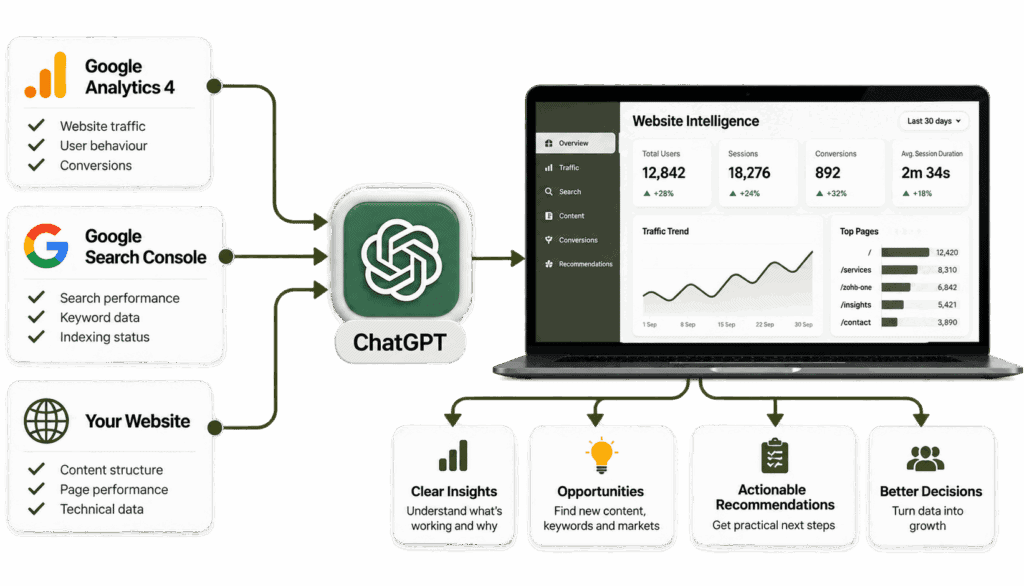
I would describe this as a website intelligence layer: turning website evidence into a repeatable cycle of analysis, decisions and improvement.
Give each system a clear role
Google Search Console shows how the site performs in Google Search, including queries, impressions, clicks and average position. Google Analytics 4 shows measured activity on the website, including traffic sources, landing pages and configured events. WordPress holds the content visitors actually see. ChatGPT helps interpret those sources together.
| Component | Role |
|---|---|
| Google Search Console | Understand search visibility and the queries bringing people to the site. |
| Google Analytics 4 | Understand visits, engagement and meaningful website actions. |
| Website content | Provide the messages, services and journeys being assessed. |
| ChatGPT | Investigate patterns and propose specific improvements. |
| Business owner or marketing team | Decide priorities and approve changes. |
| WordPress integration | Apply authorised changes and record what changed. |
The distinction matters. Reporting access should not automatically mean permission to edit the website. Analysis and execution need separate boundaries.
“How is the website doing?” is too broad to produce a useful decision. A better question is something the business can act on: which service pages attract relevant visitors, where enquiry activity has changed, or which articles support the services we want to sell.
Total traffic is only part of the picture. A technical article may attract a large audience looking for free guidance, while a service page attracts fewer visitors with a stronger buying intent. Both can be valuable, but they serve different purposes.
The same applies to conversions. An enquiry form submission, booked consultation and email click are different actions. They should not be treated as if they all represent the same business outcome.
Imagine a service page receives more Google Search impressions, but clicks barely change and enquiry submissions remain flat. That gives us a reason to investigate; it does not prove the headline or form is the problem.
I would look at which queries changed, whether they match the service, how the page is ranking, what visitors see when they arrive and how they move towards an enquiry.
ChatGPT can help organise that investigation and turn it into a specific recommendation. “Improve the SEO” is too vague. “Rewrite the opening paragraph so it answers the service question represented by these search queries” is something a person can assess.
For lower-traffic sites, confidence matters. Small changes can look dramatic as percentages, so the underlying numbers and alternative explanations should always be checked.
There are two sensible ways to start. The simplest is to provide selected report exports and website content for analysis. This lets you test the approach before adding more integration.
The next step is authenticated access to the required sources. Google provides APIs for GA4 and Search Console, while website content can be exposed through controlled integrations. The objective is not to connect everything; it is to provide only the access needed for the agreed task.
I would implement it in five stages:
- Define the business questions and outcomes.
- Confirm that the right website actions are being measured.
- Connect the necessary reporting and content sources.
- Standardise the analysis format so recommendations include evidence and uncertainty.
- Introduce website editing only when approvals, rollback and ownership are clear.
A separate dashboard can bring metrics, recommendations and change history into one place, but it is not essential for testing the model.

Once a recommendation is approved, the change should be narrow and auditable. That might be a revised meta description, clearer image alternative text or a change to a specific paragraph.
The instruction should define exactly which pages and fields can be changed. If the task is to update image metadata, that should not become permission to rewrite service pages or change the design.
Keep a record of the original value, the approved replacement and whether the change completed successfully. Then verify that the result appears as intended.
This is the same principle that applies to business automation: clear scope, defined ownership and enough visibility to understand what happened.
A weekly review should produce a short set of priorities, not another report nobody acts on. I would ask for the most important changes, the evidence behind them, any uncertainty and the next actions ranked by business value and effort.
The limitations should remain visible. Search Console and GA4 measure different things, and incomplete data should not be turned into confident conclusions.
Someone also needs to own the process: reviewing recommendations, managing access, checking failed requests and deciding whether changes achieved their purpose.
At Mason & Co, the principle is straightforward: define the information flow and controls before expanding the automation. Applied to a website, that means connecting the evidence, making the next decision clearer and following approved improvements through to verification.
If you want to explore this approach for your business, contact Mason & Co to discuss your reporting, website platform and the decisions you need it to support.