



































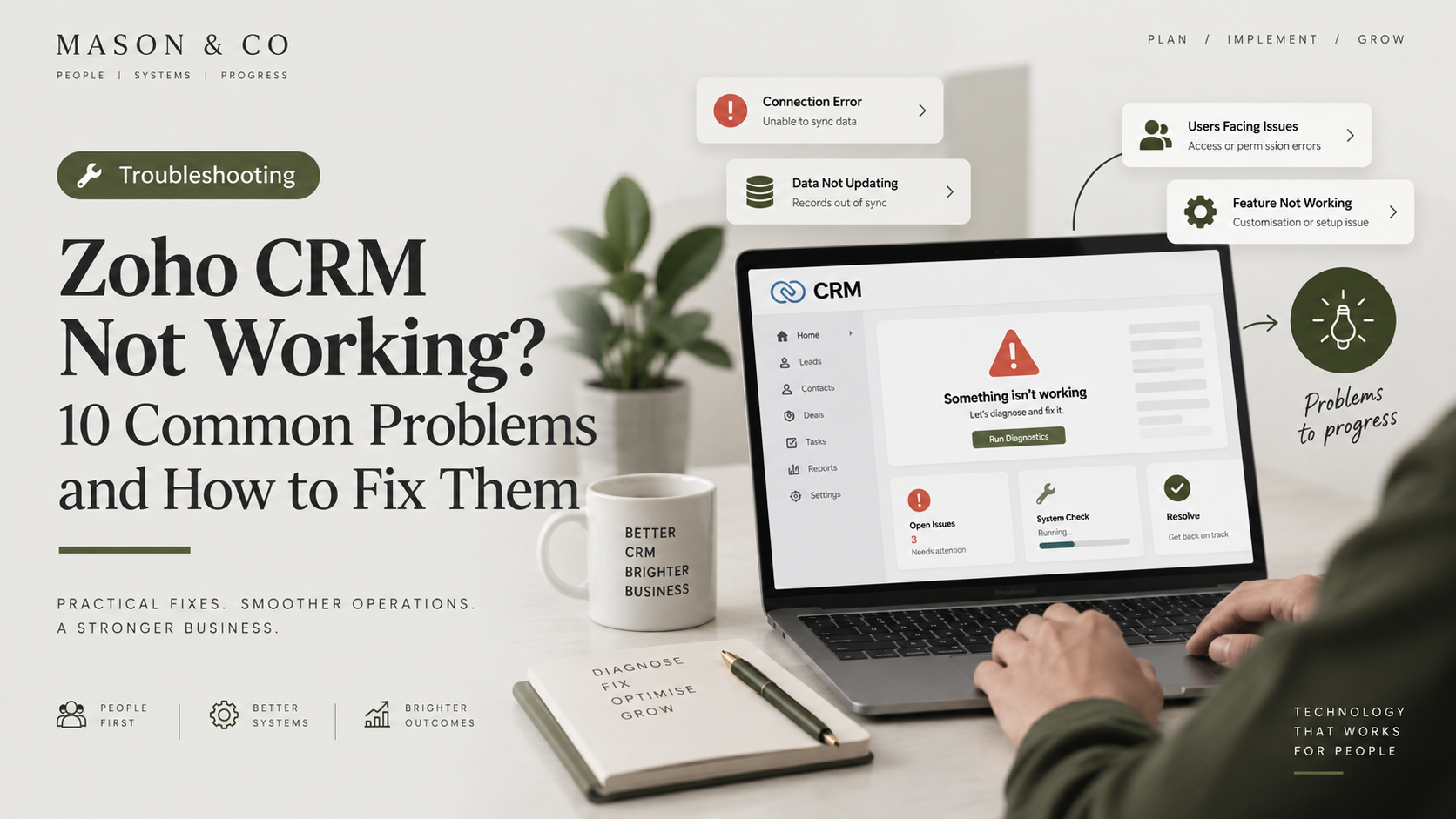
A poorly implemented CRM rarely looks obviously broken. People can still log in, leads still exist, deals still move through stages, emails still get sent and reports still produce numbers.
From the outside, the system appears to be working.
The problems usually become visible when you speak to the people using it every day. They are maintaining spreadsheets because CRM does not give them what they need, they do not trust the reports, nobody is quite sure what half the fields are for, and there are certain workflows or fields that everyone has learned not to touch because something else might break.
At that point, the issue is no longer whether Zoho CRM works. The issue is that the implementation has become difficult to understand, difficult to trust and increasingly difficult to change.
And adding more customisation usually makes that worse.
When an organisation inherits a poor CRM implementation, the natural reaction is often to start again.
Sometimes that is the right answer. But I would not make that decision until I understood what was already there.
Even badly implemented CRM environments contain years of embedded business knowledge. Fields represent historical requirements, workflows encode business rules, integrations connect other systems and users have developed workarounds that often reveal where the original design no longer matches how the business actually operates.
Rebuilding from a blank environment can remove visible complexity, but it can also remove all of that institutional knowledge at the same time.
I would diagnose first, then decide what should survive.
Documentation is useful. Reality is more useful.
I would sit with the people who use CRM every day and ask them to walk through the real process, not the process described in a document written two years ago.
Show me how a lead enters the business. Show me what happens when it is qualified. Show me when you leave CRM and open a spreadsheet. Show me what you type twice. Show me which fields you ignore, what you do not trust and where the process starts becoming difficult.
Those conversations usually reveal the real problems surprisingly quickly.
If five users have developed five different workarounds for the same process, that tells you something important about the implementation.
Once the process is understood, I would review the technical estate itself.
That normally means looking at modules, fields, layouts, pipelines, validation rules, workflows, Blueprint, assignment rules, scoring rules, custom functions, schedules, webhooks, APIs, integrations, buttons, widgets, reports, dashboards, roles, profiles and sharing rules.
The purpose is not to document everything for the sake of it.
It is to answer three questions:
- What exists?
- Why does it exist?
- What depends on it?
The third question is the one that prevents expensive mistakes.
A field that looks redundant may be feeding an integration. A workflow that appears unnecessary may be updating something downstream. A custom function nobody remembers may still be part of a critical business process.
Understanding those dependencies is what allows you to simplify safely.
Field sprawl is one of the most common signs of an ageing CRM environment.
You open a module and find Customer Type, Customer Category, Account Type, Client Type and Customer Classification.
Five fields that appear to describe roughly the same thing.
Some are mandatory. Some are populated by automation. One is used in a report. Another feeds an integration. Nobody is entirely sure which one should actually be used.
That is no longer just a configuration problem. It is ambiguity in the data model.
For every questionable field, I would determine who uses it, how often it is populated, whether automation references it, whether reports depend on it, whether integrations consume it and whether another field already provides the same information.
Then classify it:
Keep. Consolidate. Replace. Retire.
That simple exercise can remove a surprising amount of unnecessary CRM complexity.
It is tempting to start by making CRM look cleaner.
Rearrange fields. Change layouts. Hide sections. Redesign dashboards.
Those things can improve usability, but they do not fix the architecture underneath.
Start with the data model.
What is an Account in this organisation? What is a Contact? What constitutes a Lead? When does a Lead become a Deal? Which information belongs to the customer and which belongs to the transaction? Which system owns the definitive version of each important data object?
These are not configuration questions. They are business architecture questions.
If the answers are unclear, CRM configuration will remain unclear too.
One of the most damaging CRM problems is not duplicate records. It is duplicate authority.
Customer information might exist in CRM, a custom application, the finance system, a spreadsheet and an external platform.
The question is not whether those systems contain customer data. They probably need to.
The question is:
Which one is allowed to be right?
CRM may own the customer relationship. Finance may own invoices and payment status. An operational application may own service delivery. Analytics may combine all three.
Once those boundaries are clear, integrations become much easier to understand.
Without them, every system gradually becomes a partial copy of every other system, and reconciliation starts replacing automation.
Poor CRM implementations often contain automation nobody wants to touch.
A workflow triggers a function. The function updates a field. That field triggers another workflow. That workflow sends data somewhere else.
Six months later, somebody changes the original workflow and an apparently unrelated process stops working.
This is automation debt.
For every significant automation, I would document the trigger, the conditions, the action, the dependencies, the owner and the business purpose.
If nobody can explain why an automation exists, that does not automatically mean it should be deleted. It means it needs to be investigated.
Individual workflows are rarely the hardest problem. Chains are.
Imagine a Deal reaches Closed Won, which updates the Account, which triggers a function, which creates a record in another application, which returns an external ID, which then triggers an onboarding email.
Each step may be reasonable.
But unless the whole chain is understood, diagnosing a failure becomes difficult because the business sees one process while the technology sees six separate events.
For important processes, document the whole flow from business trigger to final outcome.
Not just the individual workflows.
Sometimes the issue is not poor configuration.
Sometimes CRM has simply been given too many responsibilities.
Over time, organisations add operational workflows, compliance processes, finance data, internal approvals, workforce processes, asset management and service delivery because CRM was already there and could technically support them.
Eventually the platform becomes difficult to maintain because it is no longer really functioning as a CRM.
This is where I would ask:
Is this genuinely CRM functionality, or have we built another application inside CRM?
If a process has its own users, lifecycle, data model and operational purpose, it may belong in Zoho Creator or another specialist application.
Fixing CRM sometimes means taking things out of it.
This deserves particular attention.
A field that looks unused inside CRM may be critical somewhere else.
An external application may consume it through an API. Zoho Flow may reference it. Analytics may use it. A custom function may query it.
Deleting or repurposing fields without understanding those downstream dependencies is one of the fastest ways to turn a CRM clean-up exercise into an incident.
Before retiring anything important, map the connection.
CRM → integration → destination → business process.
You do not need a hundred-page architecture document. You need enough visibility to understand the consequence of change.
CRM remediation often focuses heavily on fields and automation while ignoring access.
That is a mistake.
Permissions tend to expand over time. Someone needs temporary access. A new role is created. A profile is copied. A sharing rule is added. An integration user is given more access than originally intended.
Nobody comes back later to simplify it.
As part of remediation, I would review administrator access, roles, profiles, sharing rules, field-level permissions, API users, inactive users and integration accounts.
The objective is not to make access restrictive for the sake of it.
It is to make access intentional.
If you decide to restructure modules or fields, do not simply copy everything across.
Migration is an opportunity to improve the dataset.
Decide which records should migrate, which fields still matter, how duplicates will be handled, how old values map to new ones, which historical records need to be retained and what can be archived instead.
A new CRM structure filled with the same inconsistent data is not a new implementation.
It is the old problem with a cleaner interface.
One of the fastest ways to uncover CRM problems is to ask management for a number they care about.
“How many active customers do we have?”
If three reports produce three answers, that is a useful signal.
You may discover different definitions of active, inconsistent status fields, duplicate records, missing data, old reports using retired fields or different date logic.
The instinct is often to fix the report.
I would fix the reason the reports disagree.
There is a tendency during remediation to replace old complexity with new sophistication.
More Blueprint. More functions. More validation. More automation.
Sometimes those are exactly what is required.
But I would first ask whether the process itself can be simpler.
If a Deal has fourteen stages, do all fourteen represent meaningful business states? If users complete forty fields, are all forty necessary? If six approvals exist, do all six still add control?
Technology often exposes process complexity.
That does not mean technology should preserve it.
A mature CRM can contain years of accumulated configuration.
Trying to clean the entire environment in one large programme introduces unnecessary risk.
I would normally work through it in stages:
- Stabilise — fix anything actively causing failures or serious data issues.
- Understand — map configuration, integrations and dependencies.
- Simplify — remove duplication and unnecessary complexity.
- Standardise — establish clear data, automation and integration patterns.
- Improve — introduce better processes, reporting and automation.
- Govern — put controls around future changes.
The final step matters most.
Otherwise, the organisation will eventually recreate the same problem.
CRM complexity rarely appears because somebody deliberately designed a bad system.
It accumulates through individually reasonable decisions.
“We just need one more field.”
“Can you quickly automate this?”
“Can we connect this application?”
“Can we add another status?”
Each request makes sense on its own.
Collectively, they change the architecture.
For material CRM changes, somebody should be asking whether the capability already exists, whether data is being duplicated, what depends on the change, who will own it, how it will be tested and how it will be supported.
That does not require a heavy governance board.
It requires architectural discipline.
If I inherited an existing Zoho CRM tomorrow, I would want clear answers to a few basic questions.
Can we explain the purpose of every major module? Do we know which system owns each important data object? Can we explain what our critical automations do? Do we understand our external integrations and dependencies? Do users trust the data? Do management reports produce consistent answers? Can we make changes without being afraid of breaking something unrelated?
If several of those answers are no, I would not start by adding more features.
I would fix the foundations.
That might sound strange, but it is usually a good sign.
A well-designed CRM should not require users to understand the architecture behind it. They should not need to know which workflow updates which field. They should not need spreadsheets to compensate for missing functionality. They should not need tribal knowledge about which fields are safe to change.
They should simply be able to do their jobs.
And the technology team should be able to evolve the platform without treating every change as a potential incident.
That is what good CRM architecture gives you.
Not more configuration.
Less unnecessary complexity.
The objective is not to create the most sophisticated Zoho CRM possible. It is to create one that people trust, understand and can continue evolving without every change becoming a risk.
About Mason & Co
Mason & Co helps organisations assess, simplify and improve Zoho environments that have accumulated complexity over time.
We work across Zoho CRM, Zoho One, Creator, Analytics, integrations, automation, data and enterprise architecture, identifying what should be retained, what should be redesigned and what should be removed.
If changing your Zoho CRM has become harder than running it, adding more customisation is probably not the answer. A structured CRM architecture review usually is.