































Free 30-minute consultation | UK-based senior consultants

Not Sure Where to Start?

Zoho One works best when CRM, finance, operations, workforce and reporting are designed to work together.

If your current setup feels fragmented, overly manual or difficult to manage, we can help identify where the real problem sits.

Practical AI That Improves How Your Business Works

We help businesses use AI where it improves real operational work — not as a separate experiment.

Our approach combines Zoho, automation, reporting and governed AI so every solution is connected to real processes, reliable data and measurable outcomes.

AI Readiness Assessment Know Where Your Business Can Start

Turn AI ideas into a clearer view of what your business needs. We are developing an assessment of opportunities and readiness, covering your data, systems, people and governance.

Tell us which decisions a practical assessment must support. We will discuss requirements for the planned offering, which is in development and is not yet available to complete.

✓ Business use cases & design   ✓ UK-based senior consultants   ✓ Free 30-minute consultation   ✓ Clear scope & pricing before work begins

An AI Idea Is Only the Starting Point

An AI idea needs more than interest before it can be funded. You need to know which information is available, who owns the outcome and what must change for the work to succeed.

The planned assessment will examine evidence gaps, delivery constraints and controls. We frame decisions before technology choices, so next steps reflect your priorities and readiness.

Unclear Priorities

Teams have competing ideas but no shared basis for choosing where AI could create useful value.

Uncertain Data

Information quality, access and ownership need checking before an AI can reliably support decisions.

Missing Controls

Responsibilities, review points and acceptable use need defining before sensitive work moves into an AI process.

Delivery Gaps

Skills, systems and practices may need improvement before a promising pilot can scale safely.

A Planned Route From Snapshot to Ongoing Governance

The offering has three stages. The snapshot and Gateway are in development; this page invites an early conversation about your needs, rather than offering an assessment tool that is already live.

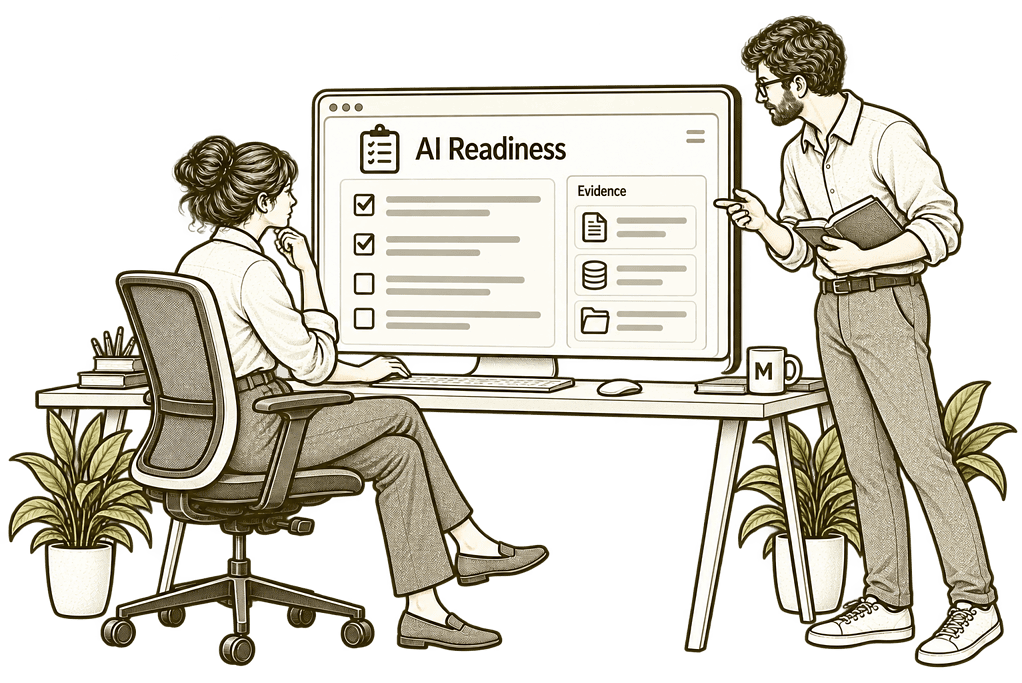
Mason & Co sketch illustrating free ai readiness snapshot for AI readiness and assessment.

Free AI Readiness Snapshot

A planned short self-assessment highlighting indicative readiness, the main gaps and sensible next steps for your organisation.
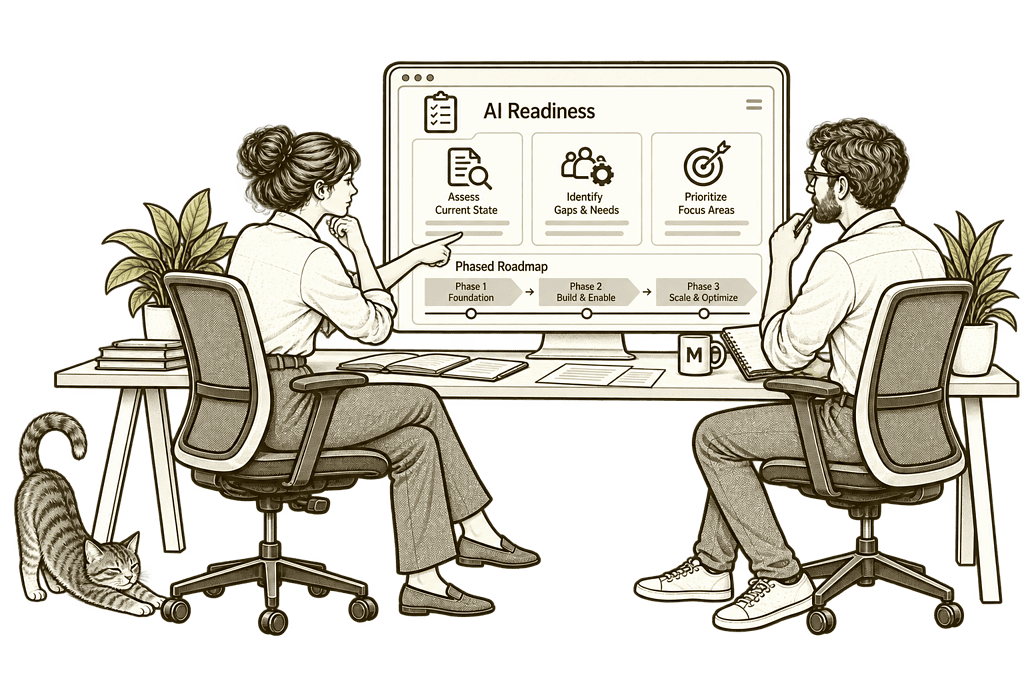
Mason & Co sketch illustrating assessment and practical roadmap for AI readiness and assessment.

Assessment and Practical Roadmap

A planned paid review using evidence and stakeholder input to prioritise opportunities, dependencies and remediation work.
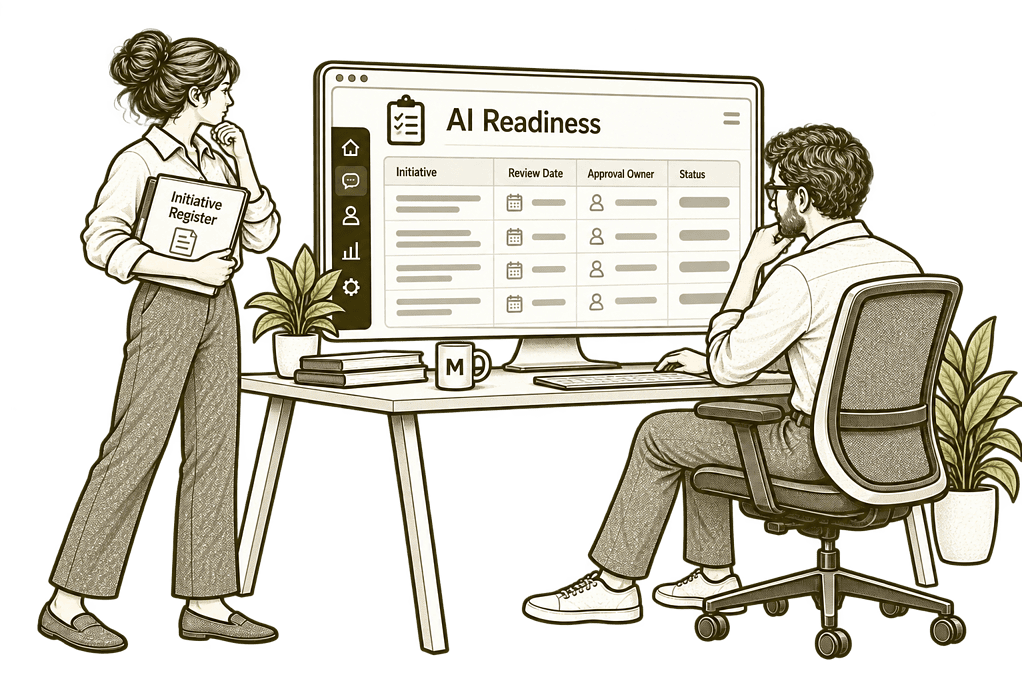
Mason & Co sketch illustrating ongoing ai governance for AI readiness and assessment.

Ongoing AI Governance

An optional planned Gateway or managed service for initiative intake, risk checks, approvals, an AI register and ongoing review.

Six Areas That Shape Your Readiness

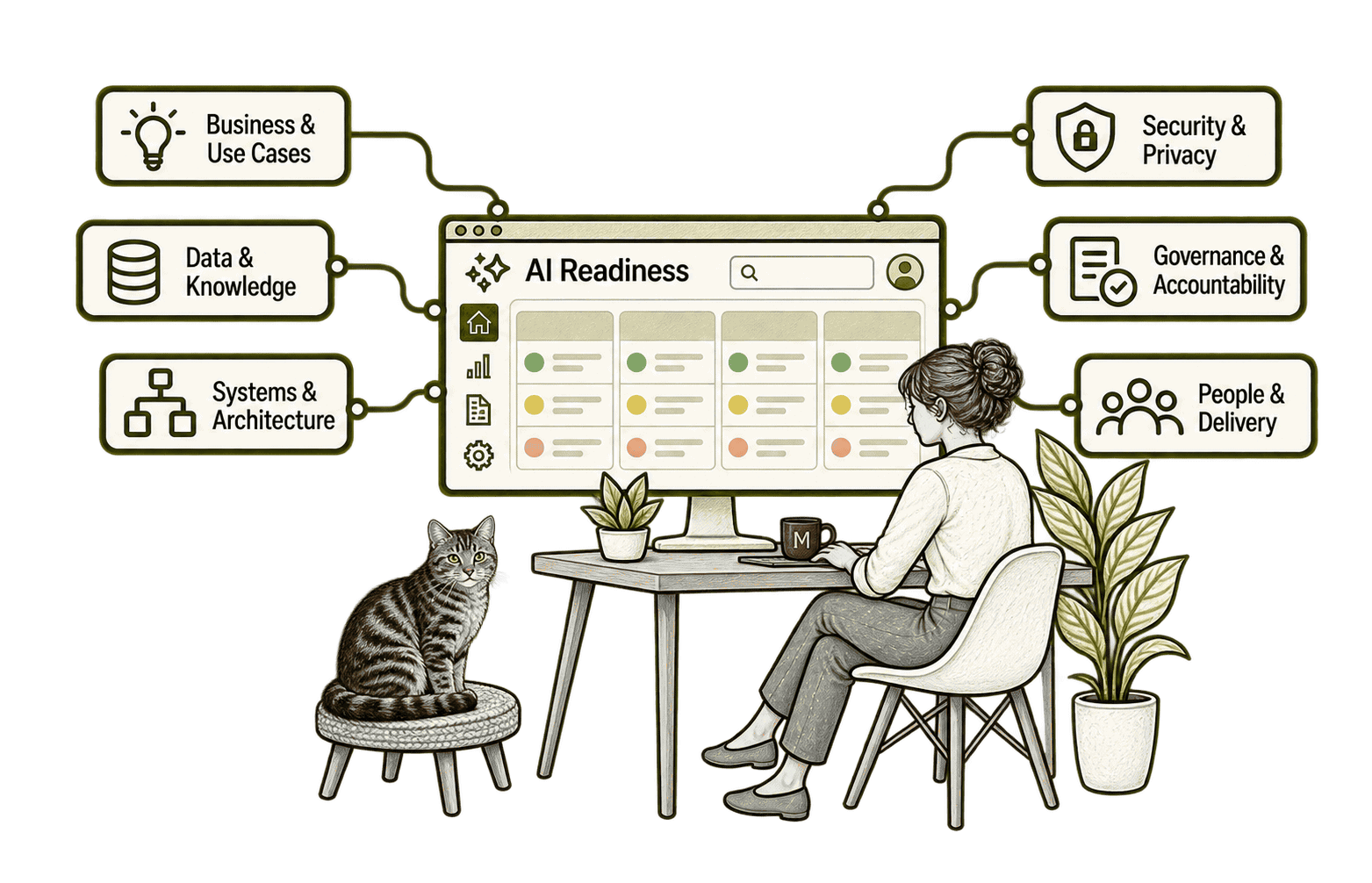
The assessment framework will examine readiness across the organisation and the proposed use case. Findings should show the evidence available, what remains uncertain and the actions needed.

Business and Use Cases

Clarify the problem, expected benefit, decision owner and a useful measure of success.

Data and Knowledge

Examine information quality, source ownership, access and the evidence needed for dependable outputs.

Systems and Architecture

Identify integration requirements, platform constraints, dependencies and the practical route into existing operations.

Security and Privacy

Review sensitive information, access boundaries, retention and the controls relevant to the proposed use.

Governance and Accountability

Define acceptable use, approvals, human oversight and who remains responsible for decisions and outcomes.

People and Delivery

Assess skills, working practices, support needs and the ability to move beyond an isolated pilot.

One Clear View of Your Readiness Status

When someone proposes an AI use case, the assessment should identify the benefit, the evidence and the work needed before a pilot. We are designing the framework around those considerations, so leaders can compare opportunities without relying on a rating or a demonstration.

Leaders would see which ideas are plausible, where evidence is missing and which dependencies need attention.

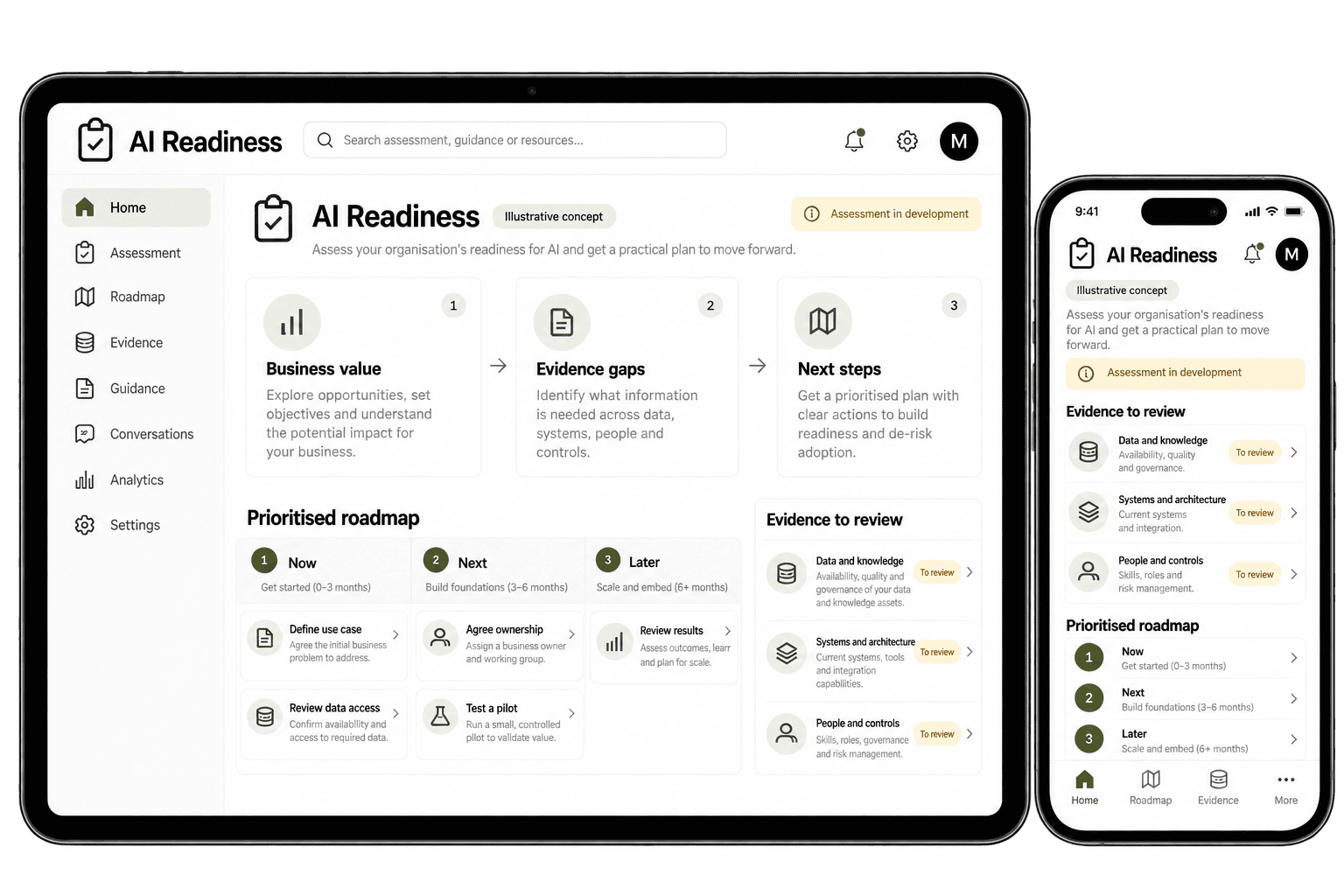
Illustrative AI Readiness assessment and roadmap on a monitor and mobile, showing evidence to review and next steps, marked as in development.

Assess the Work Before You Introduce Tools

A promising idea needs a clear purpose. A pilot needs useful data. A sensitive use case needs an owner who can decide if the checks are sufficient. The planned review examines these foundations, with clear questions about value, evidence, roles and delivery.

Define the business task and decision an AI idea should support, with an owner and useful baseline, before choosing a tool or deciding what a first pilot should test.

  • Identify the task and its business owner.
  • Describe the benefit and a useful baseline.
  • Compare the idea with simpler process improvements.

For example, a team wants AI to draft replies. The review would ask what takes time and what a useful result should change. This would help leaders distinguish a clear task from an ambition, so a later pilot follows a business need rather than interest in a tool. The team could then choose a small pilot and agree how to measure response time and editing effort.

Check whether the task has useful, current and approved data, identifying source owners and gaps so the proposed pilot starts from information the team can explain.

  • List the files and records the task needs.
  • Check dates, quality and agreed access.
  • Note missing facts and clashing source data.

For example, an idea needs service files held by many teams. The planned review would ask who owns them, how old they are and if staff may use them. Results would show useful data and gaps, helping staff sort their files before asking a model for sound help. Source owners would have a clear list of records to correct, refresh or exclude before testing begins.

Map the systems, access and handovers a proposed use needs, with delivery and support ownership clear before a pilot depends on connections that have not been checked.

  • Map the relevant apps and data flows.
  • Check supported connections and access needs.
  • Identify owners, support needs and failure handling.

For example, an assistant needs data from a work system. The planned review would check its connection and who maintains it. That would expose missing access, unclear roles or integration work early, so a useful idea is assessed alongside the actual tools and support needed to make it work. The proposed pilot would have a defined support route and known dependencies before implementation.

Review the data and actions a proposed pilot involves, with privacy, security and access questions assigned to appropriate reviewers before sensitive information is used.

  • Assess the data and actions the task involves.
  • Identify access and the relevant expert reviewers.
  • Record open privacy, security and access questions.

For example, an idea involves files that contain personal data. The planned review would check its use, access owners and specialist checks. It would record these needs for a decision maker, helping staff prepare a review rather than treating readiness as permission to share sensitive data. Any unresolved access question would stay visible until the appropriate reviewer has made a decision.

Define who owns the workflow, checks its outputs and approves consequential actions, with a clear escalation route so assistance remains accountable as the pilot develops.

  • Name the owner and needed decision makers.
  • Define where a person must check or approve.
  • Record escalation and review roles.

For example, a pilot would draft advice that affects customers. The planned review would ask who checks it, what needs approval and how concerns are raised. Leaders would see which roles are defined and which remain open, avoiding useful assistance developing without an accountable owner. The pilot could proceed with named reviewers and a clear route for escalating disputed or incorrect advice.

Assess the skills, time and support needed to test the idea, including staff learning needs and the team's capacity to review a pilot and its results.

  • Discuss the current work and affected team roles.
  • Identify learning, support and change needs.
  • Consider capacity to assess a pilot and its results.

For example, a team wants help organising files. The planned review would check how staff work, their learning needs and who can support a pilot. Findings would make delivery demands clear, helping leaders prepare the team instead of assuming that an AI account is enough for adoption. Staff would know which tasks to practise and how to report problems during the proposed pilot.

Turn readiness findings into a practical order of decisions and actions, with owners, evidence gaps and dependencies clear before leaders commit time to a proposed pilot.

  • Separate pilot ideas from work needing preparation.
  • Prioritise evidence gaps and delivery dependencies.
  • Assign decision owners and a sensible review point.

For example, one idea has useful data while another needs system access. The planned review would show the difference and propose next steps. Leaders could check the evidence and dependencies before committing time, rather than receiving a score with no clear route to act. Each priority would have a named owner, an expected result and a point at which leaders review progress.

Review readiness when a use, source or system changes, keeping earlier decisions and open questions visible so the team can assess whether the proposed approach still fits.

  • Agree which facts need regular review.
  • Identify changes that should trigger new review.
  • Keep decisions, owners and open questions visible.

For example, a pilot later gains another data source. The planned review process would make this change clear for review, with the first decision and open questions. Leaders could check new dependencies, instead of assuming that a prior finding still applies to a materially different use. The revised assessment would show what needs checking again before the team extends the pilot.

Evidence Your Leaders Can Review

Useful readiness findings answer clear questions: is the data suitable, who owns the decision and what must change before a pilot? The planned review will examine evidence and record open issues around the decisions leaders need to make before committing further resources.

Readiness score

Separate facts from claims, so leaders see which key questions need evidence before making a choice.

Preparation

Review work needed before a pilot, covering data, access, owners and time to help plan for delivery.

Information gaps

Record evidence gaps that could change decisions about planned AI deployment.

Process dependency

Identify system and process dependencies, showing what must happen before planned use can be tested.

Staff capacity

Assess available skills, time and support responsibilities before committing colleagues to an AI pilot.

Risk factors

Review sensitive data, access and planned steps, noting where specialist review is needed.

Team preparation

Review practices and learning needs so the approach fits the people who would use it.

AI-readiness review

Plan checks as uses develop, keeping facts and roles clear rather than treating one review as proof.

From a Promising Idea to a Decision You Can Explain

A business wants to use AI to prepare customer responses. The assessment first examines the work involved and the intended benefit. It then checks source information, access, review responsibilities and the systems needed to support the process. The resulting roadmap separates what can be piloted now from the data, controls or skills that need attention first.

This illustrates the assessment approach being developed. The free snapshot will be an indicative self-assessment; it will not certify compliance or replace a formal audit.

AI readiness framework connecting business use cases, data, systems, security, governance and people.

Wherever You’re Starting, the Design Matters

Interest in AI, competing ideas and missing evidence have several causes. We discuss the business decision and dependencies before recommending a pilot, systems review or preparatory work.

Starting Early

We frame the decision and identify evidence, owners, tools and controls a readiness review should assess. This gives preparation a clear scope before technology is selected.

Already Testing AI Use

We discuss current pilots, the data behind their results and the roles for using them. Existing learning can inform the planned review, with attention focused on open readiness questions.

A Clearer Starting Point

Not sure whether the AI gap is process design, data quality, systems or capacity? Our Business Systems & Operations Audit can examine foundations while our AI assessment is being developed.

You receive a structured view of the main issues and recommended priorities, giving you a practical basis for deciding what to improve next.

What the Detailed Assessment Is Being Designed to Deliver

Agree the scope

Select the business area, candidate use cases, stakeholders and evidence needed for a proportionate review.

Review the evidence

Examine relevant documents, systems and practices, distinguishing verified findings from assumptions and gaps.

Identify opportunities

Compare candidate use cases by potential value, feasibility, risk and the prerequisites they depend on.

Explain the gaps

Describe weaknesses, missing evidence and practical controls in language that business owners can act on.

Prioritise the roadmap

Sequence actions with suggested owners and dependencies, separating immediate pilot work from necessary remediation.

Plan ongoing review

Agree how readiness and controls should be revisited as use cases, suppliers and business requirements change.

The framework, questions, report format, delivery scope and pricing are still being developed and validated. An early conversation can help shape the offering; it does not enrol you in a live automated assessment or subscription.

Different Businesses. Different Key Requirements.

The same AI idea can face different working conditions. A consultancy may review files and proposals; a distributor may assess service data; a recruiter may examine approved candidate records. The planned framework will assess those differences and identify the evidence each use needs.

Legal & Claims Management

Assess document access, professional review and data handling before choosing AI support for legal and claims.

Logistics & Distribution

Examine operational data, systems and owners before proposing AI support for deliveries, stock or enquiries.

Insurance & Loss Adjusting

Examine claims information, permissions and ownership before considering AI assistance for summaries or administration.

Recruitment & Workforce Agencies

Examine approved candidate data, review roles and systems before choosing AI uses across recruitment and staffing.

Financial Services & Lending

Assess sensitive data, approvals and evidence before considering AI support for financial customer processes.

Property & Housing Associations

Review tenant data and access roles before selecting AI support for enquiries, repair updates or documents.

Charities & Not-for-Profits

Examine beneficiary data, funding work and capacity before prioritising AI support within the charity’s resources.

Construction & Engineering

Assess project records, handovers and review roles before proposing AI support for notes, planning data or site documents.

Why Mason & Co

We bring business process, enterprise architecture and practical implementation into the same conversation. The assessment is intended to help you decide what to do next and why, with a roadmap that connects opportunities to the work needed to deliver them.

Business first

Start with the work your team needs to complete and the outcome that matters.

Architecture and delivery

Consider the systems, information and controls around the workflow alongside its practical implementation.

Clear responsibilities

Agree who checks the output, approves actions and owns the process after the pilot.

A sensible next step

Use evidence from a focused review or pilot to decide what deserves further investment.

Explore practical OpenAI and Claude use cases, or our wider AI and automation services.

Your Questions Answered

Not yet. The snapshot and its report workflow are being developed. You can contact us to discuss your readiness requirements and interest in the planned offering.

The planned snapshot uses your own answers to provide indicative findings. The paid assessment is intended to add evidence review and stakeholder input, with a more detailed assessment and prioritised roadmap.

No. The assessment is intended to examine your organisation and use cases across technologies. Platform selection follows the requirements and evidence rather than determining the score.

No. An indicative score or assessment report is not a certification or guarantee. Applicable legal, regulatory and assurance requirements need appropriately scoped specialist review.

It is a planned follow-on capability for managing AI initiatives, assessments, approvals, an AI register and monitoring. Its scope and delivery model still need validation; a live subscription is not available through this page.

The planned report will explain readiness findings, evidence gaps, prioritised opportunities, risks and dependencies, followed by a sequenced roadmap. The final report format and engagement scope are still being defined.

Use the enquiry button to tell us about your organisation, current AI use and the decisions you need to make. We can discuss the planned assessment without asking for sensitive evidence before an agreed handling process.

What Does Your Business Need Before Introducing AI?

You may be weighing up AI opportunities, reviewing existing experiments or trying to understand whether your data, processes and controls are ready. A useful assessment needs to address the decisions your organisation faces.

Tell us what you need to evaluate and what evidence would help you act. We will discuss your requirements and the planned assessment, which is currently in development.

30 minutes. No charge. No obligation.