


































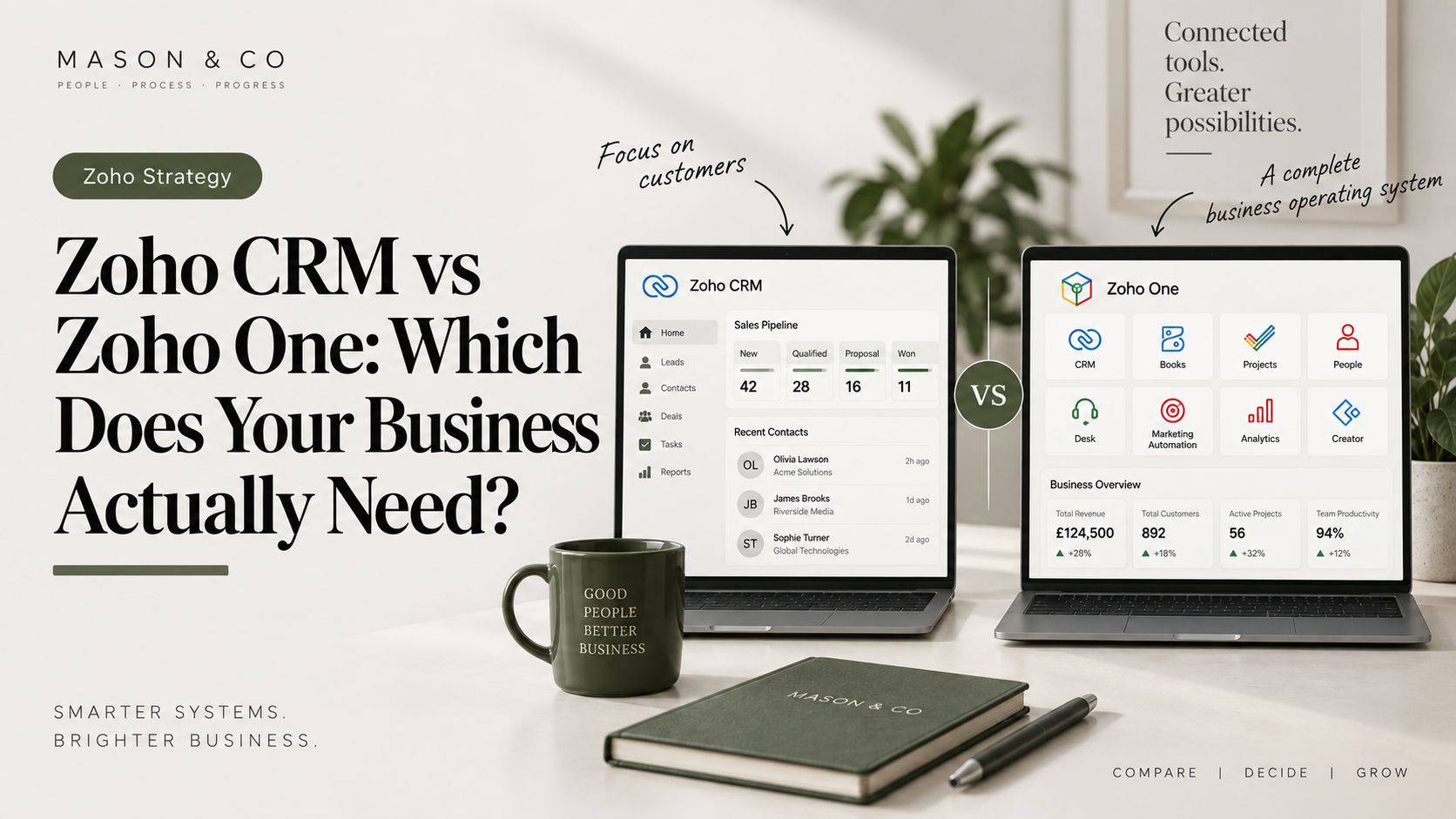
One of the first decisions organisations make when considering Zoho is whether they need Zoho CRM or Zoho One.
On the surface, it looks like a licensing question.
Do you buy the CRM product you need today, or the wider suite of applications you may need tomorrow?
I think that is the wrong way to frame it.
The better question is:
Are you trying to improve customer relationship management, or are you trying to build a more connected operating platform for the business?
Those are very different objectives.
Zoho CRM can be a substantial platform in its own right. Zoho One gives you access to a much broader ecosystem spanning sales, service, finance, analytics, automation, custom applications, collaboration and other business functions.
But more applications do not automatically create more value.
In fact, choosing Zoho One without thinking about the architecture can leave an organisation with exactly the problem it was trying to solve: too many systems, too much duplication and no clear view of how everything fits together.
So I would make the decision based on the operating model you are trying to create, not the size of the product catalogue.
If your main problem is that sales teams are working from spreadsheets, customer information is fragmented and opportunities are difficult to track, Zoho CRM may be exactly what you need.
You can manage leads, contacts, accounts, deals, activities, pipelines, workflows, reporting and a significant amount of automation without immediately introducing a wider application estate.
There is nothing inherently immature about choosing CRM rather than Zoho One.
Sometimes it is the better architectural decision.
The problem comes when the requirement is actually much broader.
Perhaps Sales needs CRM, but Finance also needs better integration. Customer Service needs case management. Operations has processes sitting in spreadsheets. Management cannot report across departments. Documents are being handled manually and several teams are using separate automation tools.
At that point, the question is no longer really about CRM.
It is about how the organisation’s systems work together.
That is where Zoho One becomes much more interesting.
It is worth making this clear because CRM is sometimes underestimated when compared with the wider Zoho One proposition.
A well-designed Zoho CRM implementation can support a substantial customer lifecycle.
You can manage lead capture, qualification, opportunity management, account and contact relationships, sales activity, workflow automation, approvals, Blueprint processes, forecasting, reporting and integrations with other systems.
For organisations with a focused sales or relationship-management requirement, that can be enough.
I would not introduce additional applications simply because they are available.
Every application you add creates another capability, but potentially another data model, permission structure, integration requirement and support dependency as well.
The objective is not to use as much of Zoho as possible.
It is to use the right amount of Zoho for the business problem.
The case for Zoho One becomes stronger when a business process does not stop at CRM.
Consider a relatively straightforward customer journey.
A prospect submits an enquiry. Sales qualifies it in CRM. A Deal is created. A contract needs signing. The customer needs onboarding. Operations needs information. Finance needs to invoice. Customer Service needs access to the relationship. Management wants to understand performance across the entire lifecycle.
You can solve each of those requirements with separate technologies.
Or you can start thinking about them as one connected business process.
That is the real opportunity with Zoho One.
CRM can manage the commercial relationship. Zoho Sign can support agreements. Creator can manage a bespoke operational process. Books can manage finance. Desk can support service. Analytics can bring information together. Flow can orchestrate processes between applications.
The value does not come from owning all those products.
It comes from designing how they work together.
This is where I would be careful.
Zoho One provides access to a very broad set of applications, which can make the commercial proposition look compelling compared with buying multiple standalone products.
But access to applications and a coherent technology platform are not the same thing.
If every department simply chooses whichever Zoho application appears to solve its immediate requirement, the organisation can still create application sprawl.
Sales starts using CRM.
Marketing introduces Campaigns.
Operations builds something in Creator.
Another team creates a separate application.
Finance uses Books.
Customer Service adopts Desk.
Teams begin creating their own Zoho Flows.
Management adds Analytics.
Before long, the organisation has a substantial Zoho estate but no agreed architecture underneath it.
Technically, everything is inside Zoho One.
Operationally, it may still behave like a collection of disconnected systems.
If I were assessing whether an organisation needed Zoho One, I would start by mapping business capabilities rather than opening the Zoho application catalogue.
For example:
| Business capability | Potential Zoho platform |
|---|---|
| Customer relationship management | Zoho CRM |
| Marketing automation | Zoho Campaigns / Marketing Automation |
| Customer service | Zoho Desk |
| Finance | Zoho Books |
| Bespoke operational processes | Zoho Creator |
| Digital signatures | Zoho Sign |
| Cross-application automation | Zoho Flow |
| Management reporting | Zoho Analytics |
This immediately changes the conversation.
Instead of asking, “Which Zoho apps should we deploy?”, you start asking, “Which business capabilities actually need improving?”
Some may already be well served by existing systems.
Some may belong in Zoho.
Some may not justify change at all.
Zoho One should not automatically mean replacing everything.
This is another misconception I would avoid.
Choosing Zoho One does not mean Zoho needs to become the only technology platform in the organisation.
Most established businesses already have systems that work perfectly well.
An ERP.
A specialist operational platform.
A payroll system.
A data platform.
Industry-specific software.
Replacing a mature application simply because Zoho One contains something similar may create more risk than value.
A stronger architecture may be:
Zoho for customer-facing and workflow capabilities + existing specialist platforms + a controlled integration layer.
The objective should be coherence, not purity.
The best platform is rarely the one supplied entirely by a single vendor.
It is the one where the boundaries between systems are deliberate and understood.
There is an assumption that buying an integrated suite removes the need for integration architecture.
I would argue the opposite.
The more capabilities you introduce, the more important architectural decisions become.
Which application owns the customer?
Where should operational data live?
Should a process sit in CRM or Creator?
Where should management reporting happen?
Which information should move between applications?
Should the integration be native, Zoho Flow, API or something else?
Who owns automation that crosses multiple systems?
What happens when one application is replaced later?
These questions become more important as the estate grows.
Zoho One gives you the components.
It does not make those decisions for you.
This is one of the areas where organisations can create unnecessary complexity very quickly.
Suppose CRM, Books, Desk and a Creator application all contain customer information.
That is perfectly reasonable.
The problem begins when all four applications can independently change the same information.
Which one is correct?
Which change wins?
Should every update synchronise everywhere?
What happens when an integration fails?
This is why I would define systems of record early.
CRM might own customer relationship information. Books owns invoices and payments. Desk owns service tickets. Creator owns the operational process. Analytics consumes information from all of them for reporting.
The applications can still share information.
They simply do not all own it.
That distinction becomes increasingly important as Zoho One expands.
Zoho One makes it relatively easy for organisations to build.
That is a strength.
It also means complexity can accumulate quickly if there are no basic controls.
Different teams can create workflows. Creator applications can be built quickly. Zoho Flows can connect systems. CRM can be heavily customised. Analytics can combine datasets.
Without some governance, the environment can grow faster than the organisation’s understanding of it.
Governance does not need to mean slowing every change down with a committee.
It can be as simple as establishing a few principles:
- every application has a clear purpose;
- important data has an authoritative source;
- integrations have an owner;
- significant automation is documented;
- new applications are reviewed against existing capabilities;
- customisation is tested before production;
- redundant functionality is retired.
The larger the Zoho One estate becomes, the more valuable those disciplines become.
I would lean towards Zoho CRM when the requirement is primarily centred around customer relationship management and sales.
That is particularly true when the organisation already has good systems for finance, operations, service and reporting, and there is no compelling reason to replace them.
CRM is also a sensible starting point when the organisation is early in its Zoho journey and needs to solve a defined problem first.
There is value in proving the operating model before expanding the platform.
Starting smaller is not a limitation if the architecture leaves room to grow.
The case becomes much stronger when several departments have connected problems rather than one department having a CRM problem.
If customer information is fragmented, manual administration crosses teams, operational processes rely on spreadsheets, reporting requires reconciliation and multiple point solutions are already being purchased, then Zoho One can provide a much more strategic opportunity.
But I would still avoid deploying everything at once.
Start with the capabilities that create the greatest business value and establish the architecture early.
Then expand deliberately.
Zoho One works best when it grows as a platform rather than arriving as fifty applications looking for a problem.
If I were helping an organisation choose between the two, I would ask five questions.
1. Is the problem primarily CRM?
If the main requirement is sales and customer relationship management, start by understanding whether CRM alone solves it.
2. How many business processes cross system boundaries?
The more processes that move between sales, service, operations, finance and reporting, the stronger the platform case becomes.
3. Are existing systems working well?
Do not replace good technology simply to increase the amount of Zoho being used.
4. Is the organisation prepared to govern a wider platform?
More capability requires clearer ownership, architecture and change control.
5. What does the technology estate need to look like in three years?
The answer should influence what you build today.
That final question matters because the cheapest or simplest decision today is not always the lowest-cost architecture over time.
This is ultimately where I think the Zoho CRM versus Zoho One conversation becomes more useful.
CRM is a product.
Zoho One gives you the components of a much broader business platform.
Neither is automatically the better choice.
If you need CRM, buying and implementing CRM well may be considerably better than deploying Zoho One badly.
If you are trying to connect customer, operational, financial and management processes across the organisation, treating the requirement as a CRM project may be too narrow from the beginning.
The decision should follow the operating model you are trying to create.
Not the number of applications included in the licence.
The question isn’t whether Zoho One gives you more. It obviously does. The question is whether your organisation has a reason, and an architecture, to use more.
About Mason & Co
Mason & Co helps organisations make architectural decisions across Zoho CRM and Zoho One before unnecessary complexity becomes embedded in the platform.
We work across CRM, Creator, Analytics, automation, integrations, data and enterprise architecture, helping organisations decide what should sit inside Zoho, what should remain elsewhere and how the overall environment should fit together.
If you’re deciding between a focused Zoho CRM implementation and a wider Zoho One platform, start with the business architecture rather than the application list.