
































Zoho CRM is highly configurable.
That can become a problem.
Because once an organisation realises how much CRM can be customised, the temptation is to make it do everything.
Add another module.
Add another workflow.
Add another function.
Add another related list.
Build another process inside it.
For a while, that works.
Then CRM gradually stops looking like a CRM and starts becoming the operational platform for the entire business.
The question isn’t whether Zoho CRM can support the process.
Often, it can.
The better question is:
Should this process actually live in CRM, or has it become a separate application?
That is where Zoho Creator becomes important.
There is some overlap between Zoho CRM and Zoho Creator, which is why the boundary isn’t always obvious.
Both can hold data.
Both can automate workflows.
Both can provide forms, reports and dashboards.
Both can integrate with other systems.
Both can support fairly sophisticated business processes.
But their architectural roles are different.
I think of them like this:
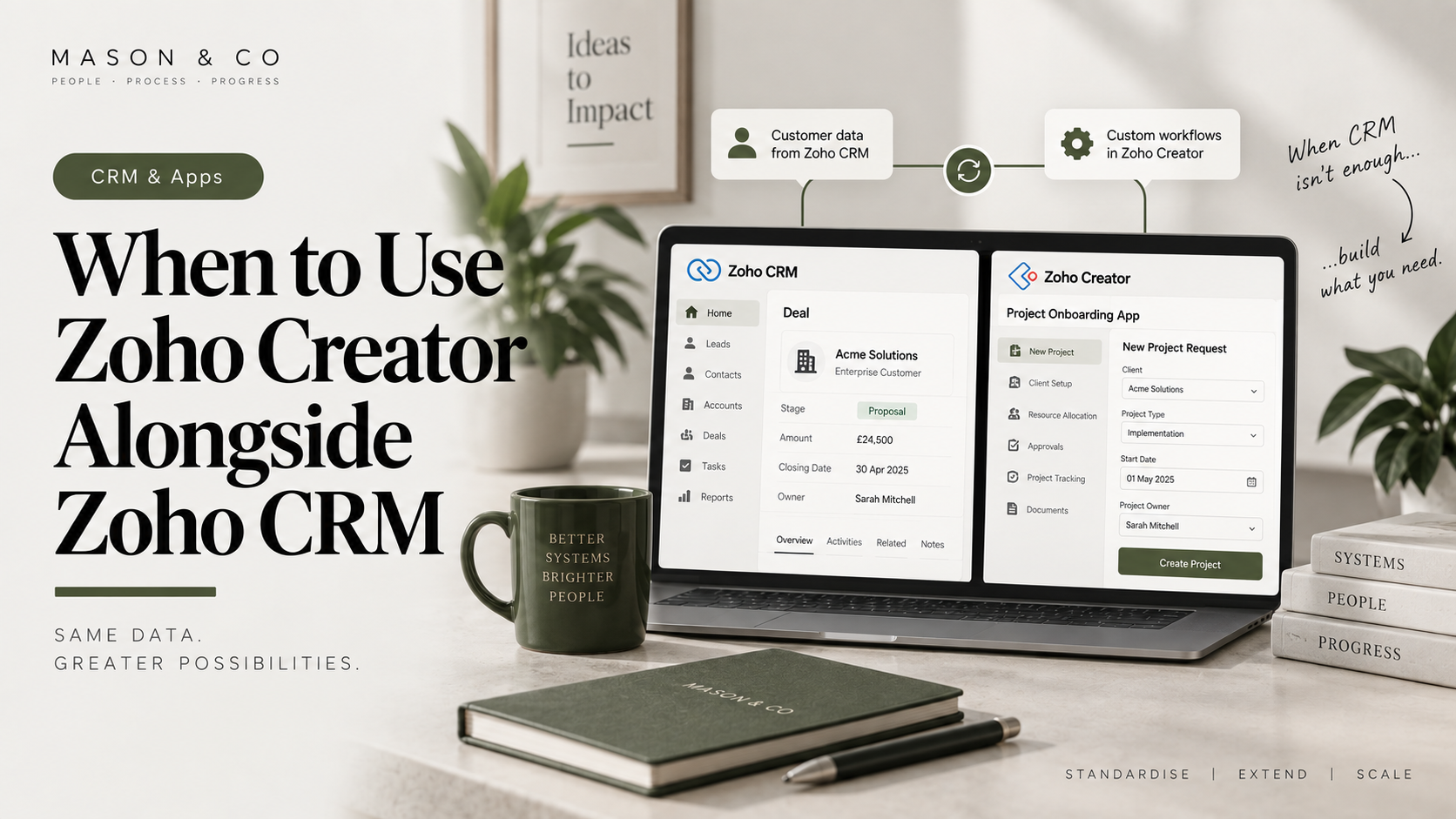
Zoho CRM manages relationships.
Zoho Creator builds applications.
CRM should normally remain centred around customers, prospects, deals, activities and the commercial relationships surrounding them.
Creator gives you a platform for building operational applications that don’t naturally belong inside that model.
Understanding that distinction can prevent a lot of unnecessary CRM complexity.
The warning signs that CRM is doing too much
There isn’t a precise point where you should move a process into Creator.
But there are some fairly obvious warning signs.
You’re creating modules that have little to do with customers
Custom modules are useful.
But if CRM starts containing modules for operational processes that have very little relationship to sales or customer management, I would question whether they belong there.
Imagine modules for:
- equipment inspections;
- workforce availability;
- stock movements;
- internal approvals;
- operational incidents;
- service delivery;
- asset management;
- compliance assessments.
You can build all of those inside CRM.
But being technically possible isn’t the same as being architecturally sensible.
If the process has its own users, lifecycle, data model and rules, it may deserve its own application.
This is another useful signal.
Suppose operations teams are logging into CRM every day but never work with leads, deals, accounts or contacts.
They are there because somebody built their operational process into a custom module.
CRM has effectively become the interface for an application that happens to have been built inside CRM.
At that point, Creator may give those users a much more appropriate experience.
You can build the application around their job rather than making their job fit around the CRM interface.
CRM works particularly well when the data naturally fits a relationship-driven structure.
Account.
Contact.
Deal.
Activity.
Related information.
But operational processes can become much more complex.
You may need:
- parent-child relationships;
- multiple subforms;
- transactional records;
- repeating activities;
- complex calculations;
- many-to-many relationships;
- operational history;
- different interfaces for different roles.
You can often force these structures into CRM.
The question is what happens afterwards.
If developers need increasingly complicated functions simply to keep the data model working, that is usually telling you something.
The platform isn’t necessarily failing.
You may be using the wrong application for the problem.
CRM gives you a CRM-oriented user interface.
That is exactly what you want for CRM users.
But imagine an operational team that needs to:
select a location → view today’s workload → open a job → complete a checklist → capture evidence → record an outcome.
They don’t necessarily need to see CRM modules, sales pipelines or customer activities.
They need an application designed around that workflow.
Creator allows you to build pages, forms, reports, dashboards and navigation around the actual operational process.
That can make a significant difference to adoption.
Good application architecture isn’t just about where the data lives.
It is also about giving users the right interface for the job they are performing.
This might sound counterintuitive.
Why move an important process away from CRM?
Because business-critical processes deserve clear boundaries.
If a complex operational process is buried among CRM customisations, changes to one environment can begin affecting another.
A CRM administrator modifies a field.
An operational function depends on it.
A workflow changes.
A downstream process breaks.
Nobody intended those things to be tightly coupled.
They simply evolved that way.
Separating a substantial operational capability into Creator can create a cleaner architecture:
CRM owns the relationship.
Creator owns the operation.
The integration between them becomes explicit rather than everything existing inside one increasingly complicated application.
There is an opposite mistake.
Once organisations discover Creator, they sometimes start rebuilding functionality that Zoho already provides elsewhere.
That doesn’t make sense either.
If CRM already handles a requirement well, use CRM.
If Desk already provides mature ticket management, consider Desk.
If Books already manages finance, use Books.
If Recruit already provides recruitment functionality, consider Recruit.
Creator is most valuable when you have a genuine business process that isn’t adequately served by an existing application.
It should fill capability gaps.
Not recreate the rest of Zoho One.
A practical example
Imagine a company sells a managed service.
The commercial journey might look like:
Lead → Opportunity → Contract → Customer.
That belongs naturally in CRM.
But after the customer signs, the operational process might involve:
- creating a service plan;
- allocating resources;
- scheduling activity;
- recording delivery;
- managing exceptions;
- capturing compliance information;
- calculating operational KPIs.
You could continue adding modules and workflows to CRM.
Or you could establish a clear boundary.
Zoho CRM
Owns:
- account;
- contacts;
- opportunity;
- commercial relationship;
- contract status.
Zoho Creator
Owns:
- service delivery;
- operational resources;
- schedules;
- operational records;
- exceptions;
- compliance;
- operational workflows.
The two applications still work together.
They simply have different responsibilities.
This is where architecture matters.
The easiest solution is often to synchronise everything.
I wouldn’t start there.
If CRM owns the customer, then CRM should remain the authoritative customer source.
Creator may need:
- CRM Account ID;
- customer name;
- location;
- service type;
- selected contact information.
That information can be passed into Creator when the operational process begins.
Creator then creates and manages its own operational records.
The CRM ID becomes the common identifier linking the environments.
The important principle is:
Don’t create two independent masters for the same information.
If somebody changes the customer’s core details, establish which application is responsible for that change.
Otherwise, you eventually create the familiar problem:
CRM says one thing.
Creator says another.
And nobody knows which is correct.
There is a tendency to assume CRM and Creator should continuously synchronise in both directions.
Sometimes they should.
Often they don’t need to.
Consider:
CRM → Creator
CRM sends customer information when the customer becomes operational.
Creator then manages the service.
Creator may only need to send a small amount of information back:
Creator → CRM
Service status.
Last service date.
Operational risk indicator.
Perhaps an overall service metric.
CRM users gain the visibility they need without CRM becoming a copy of the operational application.
That is much cleaner than synchronising every field in both directions.
This is an important distinction.
A salesperson may need to see information from Creator.
That doesn’t automatically mean the information needs to be stored in CRM.
There are several ways of exposing information across applications.
Depending on the requirement, you may be able to use:
- related information;
- embedded views;
- APIs;
- widgets;
- contextual links;
- Analytics;
- selective synchronisation.
The architectural objective should be to give users the information they need without unnecessarily creating another copy of the data.
Visibility and ownership are different requirements.
Once CRM and Creator are working together, another question appears.
Where should management reporting happen?
If the report only concerns CRM, CRM reporting may be sufficient.
If it only concerns the operational application, Creator may be sufficient.
But if management wants to understand the relationship between commercial and operational performance, neither application should necessarily carry that entire responsibility.
For example:
Sales pipeline → customers won → services activated → operational performance → revenue
That story crosses several systems.
This is where Zoho Analytics becomes valuable.
CRM contributes commercial data.
Creator contributes operational data.
Finance contributes financial data.
Analytics brings the story together.
Again, each application has a defined responsibility.
Low-code platforms make development faster.
They do not remove the need for architecture.
In some ways, they make it more important.
Because it becomes very easy to build.
A new form can be created quickly.
A workflow can be added quickly.
Another application can be created quickly.
That speed is valuable.
But without discipline, you can end up reproducing the same complexity you were trying to remove from CRM.
For significant Creator applications, I would still expect:
- a defined data model;
- role and permission design;
- development and production separation;
- change control;
- integration standards;
- error handling;
- logging;
- documentation;
- ownership;
- lifecycle management.
Low-code changes the speed of development.
It doesn’t change the need to manage software properly.
Not every complicated CRM process needs Creator.
I would generally keep the process in CRM when:
- it is fundamentally part of the sales or customer lifecycle;
- CRM users are the primary users;
- the data naturally relates to accounts, contacts, leads or deals;
- CRM workflows can support it without excessive custom logic;
- the standard CRM interface is appropriate;
- separating it would create more complexity than it removes.
There is no value in introducing another application simply for architectural purity.
The objective is simplification.
I would seriously consider Creator when several of these are true:
- the process is operational rather than relationship-driven;
- it has a substantial independent data model;
- non-CRM teams are the primary users;
- it requires a purpose-built interface;
- CRM customisation is becoming difficult to maintain;
- the process has its own lifecycle;
- there are complex transactional relationships;
- mobile or field workflows are important;
- the capability could reasonably be described as an application in its own right.
The more of those characteristics you recognise, the stronger the case becomes.
There is a simple question I find useful:
If Zoho CRM disappeared tomorrow, would this process still need to exist?
If the answer is no, it is probably genuinely part of CRM.
If the answer is yes — and it has its own users, rules, records, lifecycle and operational purpose — you may actually be looking at a separate business application.
That doesn’t automatically mean Creator.
But it should trigger the architecture conversation.
Ask how much should live there.
That distinction becomes increasingly important as a Zoho environment matures.
The strongest implementations aren’t necessarily the ones that have pushed CRM customisation the furthest.
They’re the ones where each application has a clear purpose.
CRM manages relationships.
Creator manages bespoke operational processes.
Analytics brings information together.
Other Zoho applications provide the specialist capabilities they were designed for.
And integrations connect them where there is a genuine business reason.
That produces something much more valuable than a heavily customised CRM.
It produces a platform that can evolve.
The objective isn’t to make Zoho CRM capable of doing everything.
It’s to make the overall Zoho architecture capable of supporting the business without becoming increasingly difficult to change.
About Mason & Co
Mason & Co helps organisations design, simplify and evolve Zoho environments that have grown beyond straightforward CRM implementations.
We work across Zoho CRM, Creator, Analytics, Zoho One, integrations, automation and enterprise architecture — helping organisations decide not just how to build something, but where it should live within the wider platform.
If your Zoho CRM has accumulated operational processes, custom modules and automation to the point where changes are becoming increasingly difficult, the problem may not be CRM itself. It may be time to reconsider the application boundaries.