


























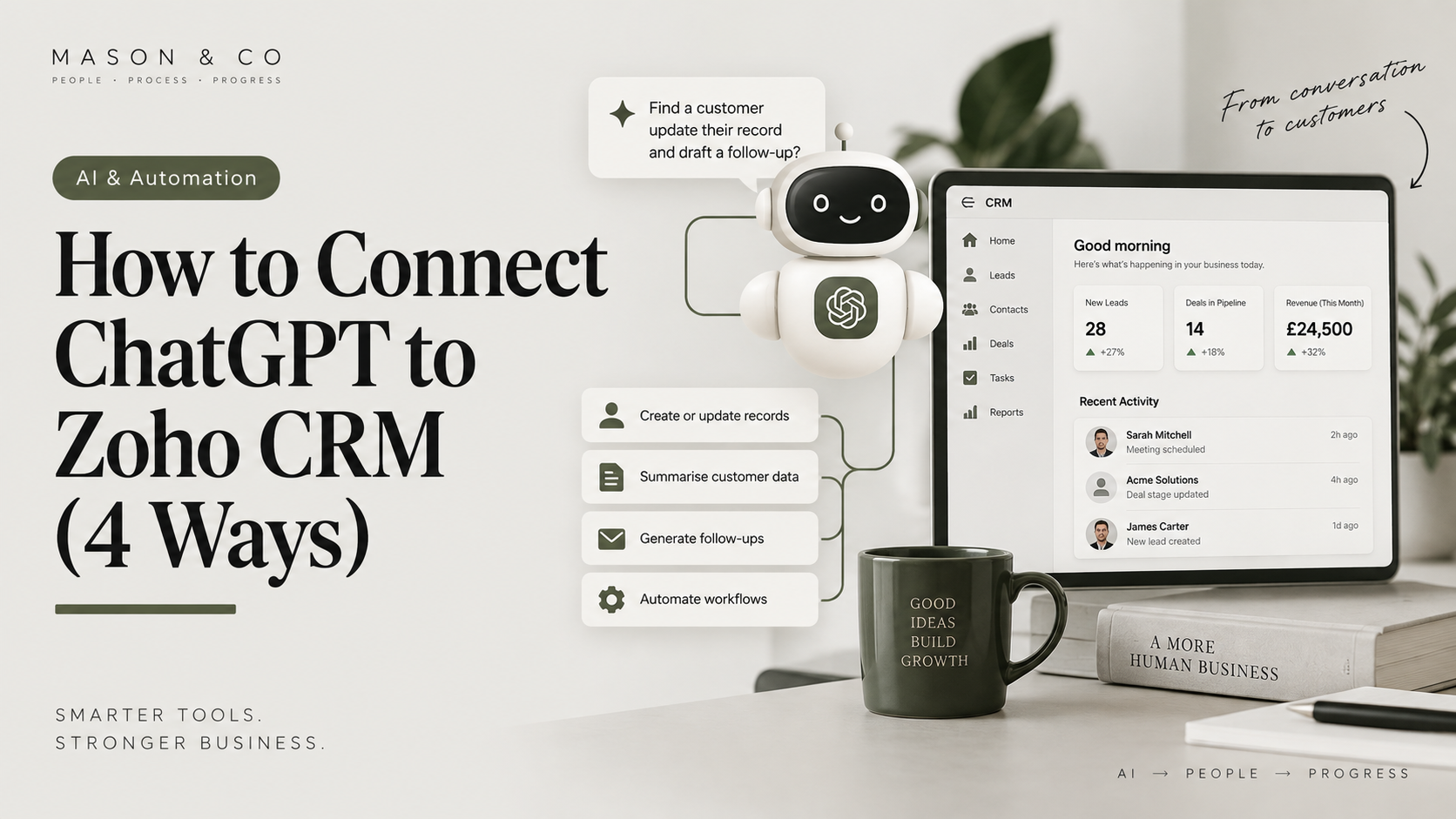
There are four practical ways to connect ChatGPT with Zoho CRM: Zoho’s built-in AI capabilities, a Deluge/API integration, workflow middleware such as Zoho Flow, or an AI agent using Zoho’s MCP capabilities.
The right option depends on what you actually want AI to do. Writing an email is very different from letting an AI agent read CRM data, update records or trigger operational workflows.
That distinction matters because the more autonomy you introduce, the more important permissions, auditability and human oversight become.
A simple way to think about it:
| What you need | Best starting point |
| Summaries, drafting and user assistance inside CRM | Zoho built-in AI |
| Automated AI processing triggered by CRM activity | Deluge + OpenAI API |
| AI workflows spanning multiple applications | Zoho Flow / middleware |
| Dynamic AI access to CRM data and actions | Zoho MCP / AI agent |
Zoho CRM now supports multiple AI model providers through its Models capability, including OpenAI, alongside Zoho’s own hosted model and other external LLM providers.
For many organisations, this is the right place to start.
Zoho CRM allows administrators to configure AI models within CRM, including OpenAI, and use them for capabilities such as record summaries, note summaries, email drafting and other in-product assistance.
Typical uses include:
- summarising CRM records before a call
- turning long notes into key takeaways
- drafting or improving emails
- generating structured information from unstructured notes
The main advantage is simplicity. Users stay inside Zoho CRM and the AI assistance appears within the application they already use.
The limitation is that you are working within the functionality Zoho exposes. If you want AI to execute a bespoke process automatically, you will usually need one of the next approaches.
Best suited to: organisations that want to introduce AI-assisted working without creating a custom integration.
The second option is to build a custom function inside Zoho.
Deluge can call external APIs, which means a CRM workflow can send selected information to an OpenAI model, receive a response and write the result back into Zoho.
For example:
A new lead enters CRM.
Zoho sends selected lead information to an AI model.
The model classifies the enquiry, produces a short summary and suggests an appropriate priority.
The result is written back into fields on the lead.
This approach provides much more control because you decide:
- what triggers the AI
- exactly which CRM data is sent
- which model is used
- how the prompt is structured
- where the result is stored
- what happens if the AI call fails
This is often a good balance between flexibility and architectural simplicity because the workflow remains primarily within the Zoho environment.
The important point is not to treat the API call as the whole solution. Production integrations need error handling, appropriate credential management, retry behaviour, logging and clear rules around what data may leave CRM.
Best suited to: structured AI workflows where the business needs more control than Zoho’s standard AI features provide.
A third option is to connect Zoho CRM to an AI service through an automation platform.
Zoho Flow is the obvious choice for organisations already using Zoho One, although platforms such as Make or Zapier can provide similar orchestration.
A workflow might look like:
Deal moves stage → AI analyses deal notes → CRM is updated → manager receives notification
This approach can be useful when a process touches multiple applications.
For example:
CRM → AI → Microsoft Teams → document repository → CRM.
The advantage is speed and visibility. A process can often be built and modified without writing significant amounts of code.
The trade-off is architectural complexity.
Every additional platform introduces another dependency, another set of credentials, another place where data moves and potentially another cost model.
For simple cross-system workflows, this is entirely reasonable. For high-volume or business-critical processes, we would normally assess whether the logic belongs closer to the core Zoho platform instead.
Best suited to: cross-application automation where speed of implementation matters more than keeping all logic inside Zoho.
This is where the architecture becomes significantly more interesting.
Zoho CRM now includes built-in support for the Model Context Protocol, or MCP. MCP allows compatible AI systems to access defined CRM capabilities as tools rather than relying on a single fixed API request.
That means an AI agent can potentially perform multi-step tasks such as:
“Show me open opportunities that have had no meaningful activity in the last 30 days, identify the most commercially important ones and prepare follow-up actions.”
The agent can then use permitted CRM tools to retrieve information, reason about it and potentially perform defined actions.
Zoho currently exposes MCP capabilities across areas including data insights, data operations and CRM configuration/process capabilities, subject to availability and permissions.
This is fundamentally different from asking ChatGPT to summarise a record.
You are giving an AI system controlled access to operational capabilities.
That makes governance critical.
Before allowing an agent to make changes to live CRM data, an organisation should define:
- what the agent can read
- what it can create or update
- which actions require approval
- what gets logged
- what happens when confidence is low
- how permissions differ between users
- where human review remains mandatory
Best suited to: organisations exploring agentic automation and multi-step operational AI.
The technology is only useful when attached to a well-defined operational problem.
Good early use cases include:
Record summaries
Give sales or service teams a short operational briefing before engaging with a customer.
Lead classification
Analyse enquiry content and assign categories, urgency or routing information.
Call and meeting notes
Convert unstructured notes or transcripts into useful CRM information.
Email drafting
Prepare customer communication based on CRM context while keeping final approval with the user.
Data quality assistance
Extract structured information from free text and identify incomplete or inconsistent records.
Exception identification
Surface records that require attention based on activity, data and operational rules.
Any integration should follow data minimisation.
If the AI only needs five CRM fields to complete a task, do not send twenty.
It is also important to distinguish API usage from simply copying business information into a personal AI account.
OpenAI states that inputs and outputs from its API platform are not used to train its models by default unless an organisation explicitly opts in.
That does not remove the organisation’s responsibility to assess data protection, retention, access controls and contractual requirements before connecting business systems to an external AI provider.
For sensitive environments, AI architecture should be reviewed alongside information security and data governance rather than introduced as an isolated automation project.
The most important question is not “what can ChatGPT do?”
It is:
What should an AI system be allowed to do without human intervention?
We would be cautious about immediately allowing AI to:
- send binding customer communications
- approve financial commitments
- alter sensitive records without review
- make regulatory or compliance decisions
- delete CRM information
- bypass established approval controls
The higher the consequence of an action, the stronger the control model should be.
That is particularly important in regulated environments.
Any integration should follow data minimisation.
If the AI only needs five CRM fields to complete a task, do not send twenty.
It is also important to distinguish API usage from simply copying business information into a personal AI account.
OpenAI states that inputs and outputs from its API platform are not used to train its models by default unless an organisation explicitly opts in.
That does not remove the organisation’s responsibility to assess data protection, retention, access controls and contractual requirements before connecting business systems to an external AI provider.
For sensitive environments, AI architecture should be reviewed alongside information security and data governance rather than introduced as an isolated automation project.
There is no single answer.
If the requirement is:
“Help users write and summarise information.”
Start with Zoho’s native AI capability.
“Automatically analyse records as part of a workflow.”
Consider Deluge and an AI API.
“Connect several applications quickly.”
Consider Zoho Flow or suitable middleware.
“Allow AI to reason across CRM data and perform controlled actions.”
Explore Zoho MCP and an agent-based architecture.
The mistake is starting with the technology.
Start with the operational problem, decide what AI needs to see and what it should be allowed to do, then choose the simplest architecture that satisfies those requirements.